Comprehensive Mesh WiFi Review 2025
Mesh WiFi in 2025: The Definitive Guide to Seamless Whole-Home Connectivity
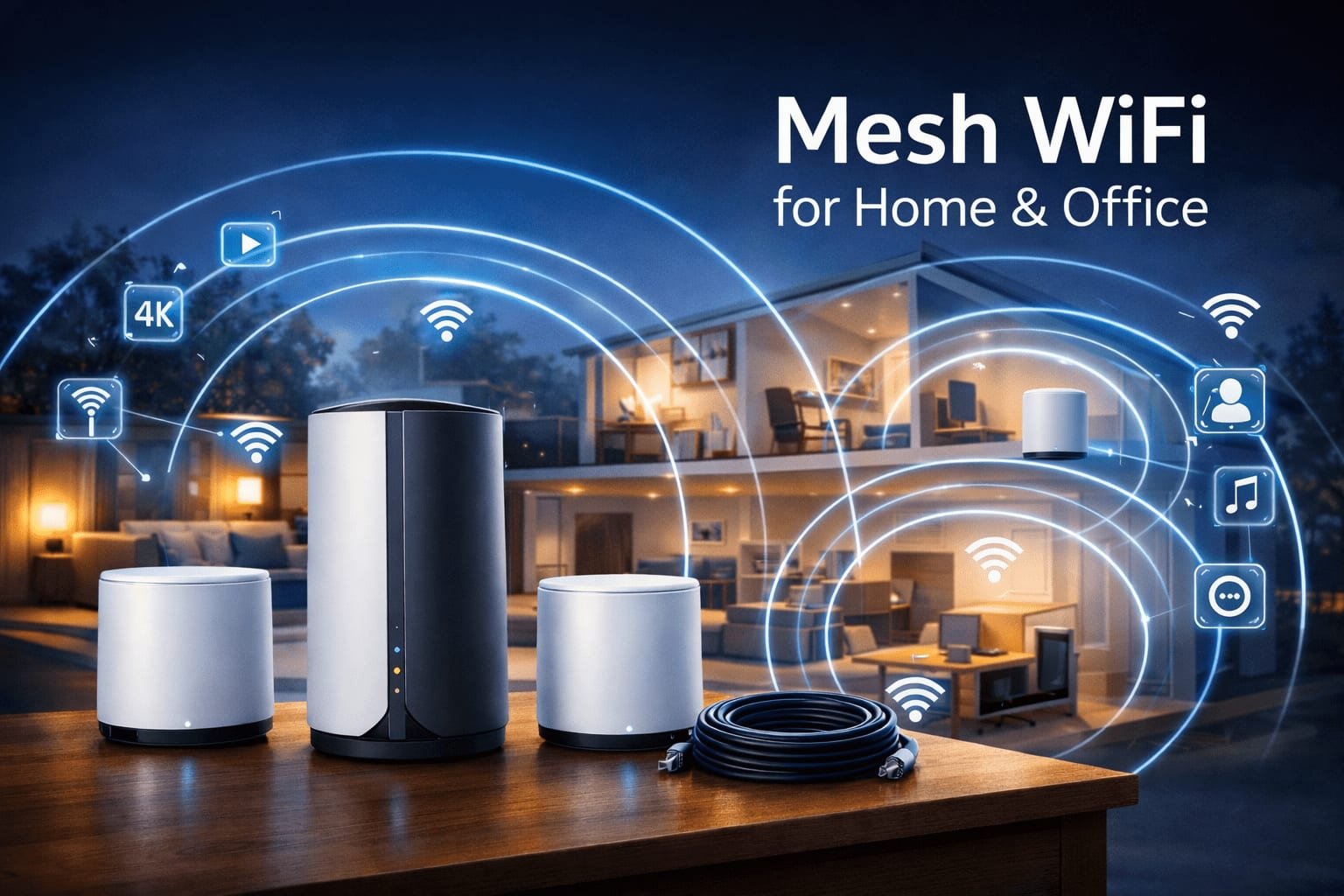
Mesh WiFi has become the dominant residential networking solution in 2025, especially for households that struggle with dead zones, signal drop-offs, or frequent buffering. Unlike a single traditional router that tries to broadcast WiFi from one location, a mesh system distributes coverage across multiple coordinated nodes. These nodes work together to create a unified, self-optimizing wireless fabric that spans your entire home without gaps or performance inconsistencies.
What Mesh WiFi Is
A modern mesh WiFi system includes a primary router connected to the modem and several companion nodes placed throughout the property. These nodes communicate with one another to maintain a single network name and password, ensuring that your devices always latch onto the strongest point automatically. The system manages transitions between nodes in real time, so you can walk across floors or rooms without losing connectivity or experiencing the delays that plague traditional extenders.
Current-generation mesh systems support advanced wireless standards such as WiFi 6, WiFi 6E, and WiFi 7. These standards significantly increase bandwidth efficiency, reduce signal contention, and introduce the 6 GHz band, which provides cleaner spectrum and dramatically enhances performance for homes filled with high-demand devices.
Editor’s pick for mesh wiFi Routers


Why Mesh Outperforms Traditional Routers
A conventional router is effective only when the home layout is simple and the coverage area modest. Distance, walls, concrete, electrical wiring, and even furniture can degrade the signal. Many users try to fix this by adding cheap extenders, but those devices often create separate networks, cause latency spikes, and break seamless roaming.
Mesh systems solve all these issues by placing multiple intelligent access points closer to where wireless devices are actually used. They coordinate channel selection, load balancing, and roaming decisions across the entire home. Most quality systems also support wired backhaul, meaning nodes can be connected with Ethernet for even greater reliability and for freeing up wireless capacity. This results in higher throughput, lower latency, and more stable connections across floors, corners, and large rooms.
Core Mesh Technologies in 2025
Mesh WiFi in 2025 is powered by several essential technologies:
- WiFi 6 and 6E: Provide higher capacity, improved spectral efficiency, and access to the high-performance 6 GHz band (6E). This band is particularly beneficial in neighborhoods with crowded 2.4 GHz and 5 GHz environments.
- WiFi 7: Introduces 320 MHz channel width, 4K-QAM modulation, and Multi-Link Operation (MLO). These features nearly double theoretical capacity and drastically cut latency.
- Tri-band and Quad-band Architectures: Add extra radios, allowing dedicated communication channels between nodes. This prevents client devices from competing with node-to-node traffic.
- AI-Assisted Optimization: Many high-tier systems now include algorithms that auto-tune the network, reduce interference, and intelligently distribute client load.
The result is predictable performance even in dense digital environments, such as homes filled with smart devices, video conferencing setups, and entertainment systems.
Real-World Performance and Coverage
Mesh networks are designed to deliver stable coverage across an entire property. Typical 2- or 3-node systems cover 4,500 to 7,000 square feet, while advanced WiFi 7 mesh systems can reach 8,000 to 10,000 square feet with additional satellites.
However, real-world performance depends significantly on the building structure. Dense materials like concrete, metal frames, and brick walls reduce wireless penetration. Proper node placement—ideally central, elevated, and unobstructed—is critical. In multi-floor homes, installers often place one node per floor to ensure uniform performance. Wired backhaul, when available, eliminates many coverage challenges and is the preferred configuration for maximum stability.
WiFi 7 Mesh: The New Standard for High-End Users
WiFi 7 mesh systems represent the highest tier in residential networking. They are designed for users who rely on multi-gigabit broadband, heavily interactive applications, or smart homes with dozens of high-load devices. Several technological advances distinguish WiFi 7 mesh from earlier generations:
- 320 MHz Channels: Twice the typical width of WiFi 6, allowing massive data throughput.
- 4K-QAM Modulation: Enables up to 20 percent more data encoding within the same spectrum.
- Multi-Link Operation (MLO): Lets devices simultaneously connect across multiple bands, improving speed and lowering latency.
- Multi-Gig Ethernet Ports: Supports wired connections at 2.5G, 5G, or even 10G speeds.
This generation is ideal for environments requiring ultra-low latency, such as cloud gaming, AR/VR experiences, 8K media streaming, and high-speed workstations.
The Everyday User Experience
Modern mesh systems are engineered for simplicity. Most setups begin with a guided mobile app that walks the user through connecting the main node, identifying optimal satellite placements, and configuring essential settings such as network name, password, and parental controls.
Mesh ecosystem apps now commonly offer tools for:
- Monitoring device signal strength and bandwidth usage
- Creating temporary or long-term guest networks
- Implementing parental controls and usage schedules
- Prioritizing devices or applications
- Checking for and applying automatic firmware updates
Once configured, the system largely manages itself, minimizing the need for technical maintenance.
Ideal Scenarios for Mesh Systems
Mesh WiFi delivers the greatest value in the following use cases:
- Homes larger than 2,000–2,500 square feet
- Multi-level properties
- Buildings with materials that block wireless signals (stone, reinforced concrete, metal)
- Households with many smart devices, sensors, and cameras
- Remote work environments require stable video conferencing across multiple rooms
- Homes that previously relied on weak extenders or routers are struggling to reach distant corners
By consolidating the entire home under one unified architecture, mesh eliminates the complexity of juggling multiple SSIDs or unreliable repeater setups.
How to Select the Right Mesh System
When guiding your readers or making a personal purchasing decision, evaluate systems based on:
- WiFi Standard: WiFi 6 for mainstream needs; WiFi 6E or WiFi 7 for heavy demand, congestion-prone homes, or future-proofing.
- Bands and Backhaul Options: Tri-band or quad-band configurations significantly improve performance in larger spaces. Wired backhaul is highly recommended where possible.
- Coverage Claims vs. Real Layout: Homes with thick walls or irregular shapes may require additional nodes.
- Ethernet Support: Multi-gig ports enable faster wired backbones and future-ready networking.
- Software and Security: Look for strong parental controls, threat detection, automatic updates, and transparent subscription policies.
This framework helps determine whether premium features—such as WiFi 7 or advanced security suites—justify additional investment.
Advantages and Disadvantages of Mesh WiFi
Advantages
- Exceptional coverage across large or complex homes
- Seamless roaming with a single unified network
- Scalable architecture that allows adding nodes over time
- Easier setup and maintenance through modern apps
- Low latency and high throughput with WiFi 6E and WiFi 7
Disadvantages
- Higher cost compared to single high-powered routers
- Some systems restrict advanced configurations to maintain simplicity
- Certain brands impose subscription fees for enhanced security or analytics
Many homes still function well with premium stand-alone routers, but mesh systems offer far greater consistency in complex environments.
Future Trends in Mesh WiFi
The mesh WiFi ecosystem is evolving rapidly. Over the next few years, expect the following developments to shape the market:
- WiFi 7 Adoption: As manufacturing costs drop, WiFi 7 mesh systems will become widely affordable.
- Smarter Traffic Management: AI engines will dynamically route traffic, isolate noisy devices, and optimize performance per application.
- Deeper Smart Home Integration: Mesh systems will increasingly support Matter, Thread, and emerging IoT protocols, effectively serving as unified smart home control centers.
- Multi-Gig Everywhere: Future nodes will include 2.5G/5G/10G ports by default, enabling seamless wired/wireless hybrid networks.
Ultimately, the goal is effortless connectivity—where the home network becomes as invisible and reliable as electricity, requiring minimal user involvement.
If you want, I can also convert this into a blog-ready formatted article, prepare a comparison chart for WiFi 6 vs. 6E vs. 7, or generate a product-neutral version optimized for SEO with keyword clusters.