
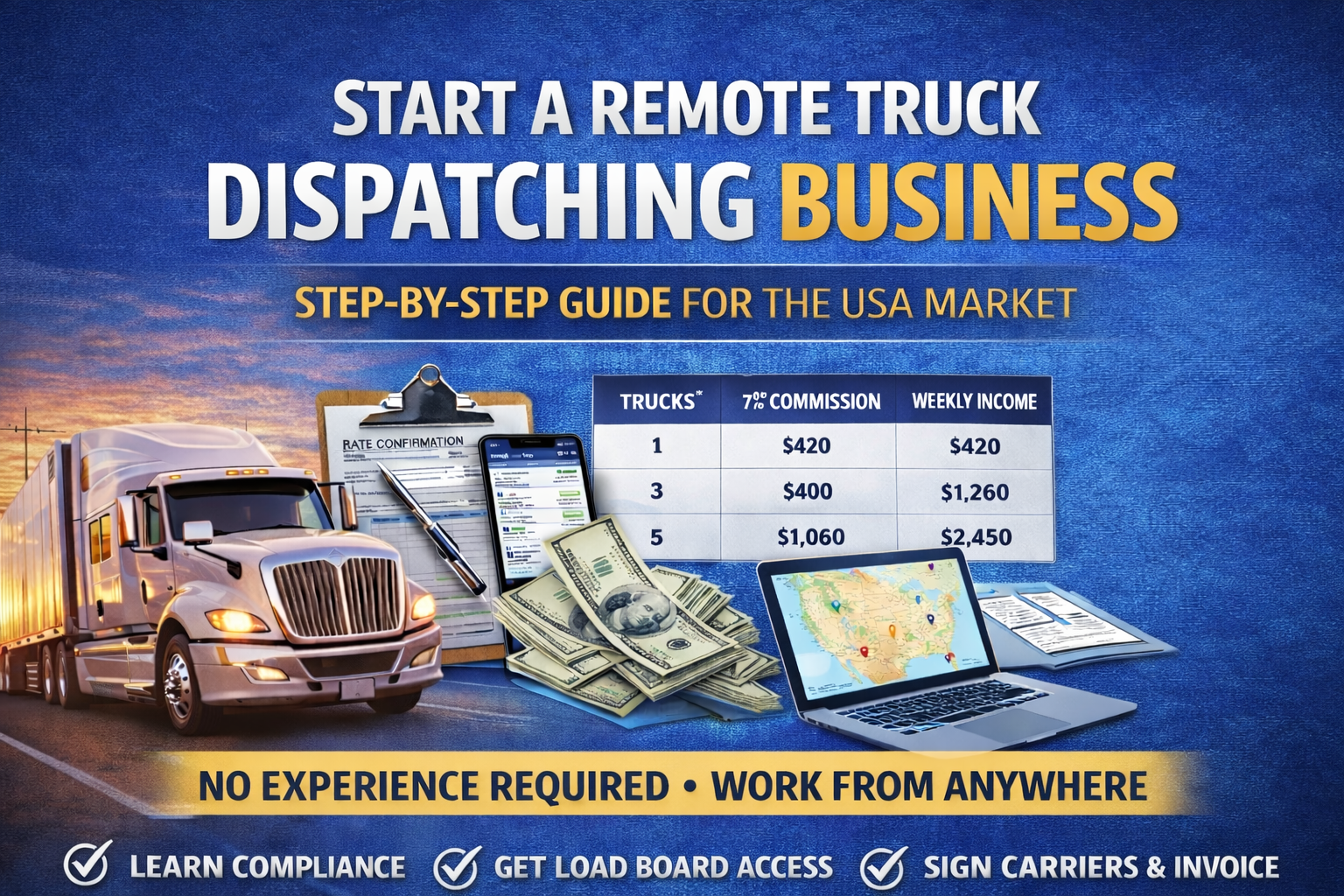
The Best Time for You to Earn Money Remotely Is Right Now — With Truck Dispatching in the U.S. Market
Remote Truck Dispatching
Million‑Dollar Opportunity
Start a scalable, remote dispatching business serving the U.S. trucking market — no truck, no warehouse, no U.S. residency required.
Why Now Is the Best Time
There has never been a better moment to position yourself in a high-demand, recession-resistant remote profession. Truck dispatching stands at the center of that opportunity. The U.S. trucking industry continues to move billions of tons of freight every year, powering retail, manufacturing, construction, food distribution, and e-commerce.
Owner-operators outsource load booking, rate negotiation, and compliance to professional dispatchers.
Work from any country — all you need is a laptop, internet, and structured execution.
Loadboards, ELD tracking, and freight analytics give you the edge from day one.
With truck dispatching, you earn remotely by managing U.S.-based carriers from anywhere. You do not need to own a truck. You do not need a warehouse or inventory. The more trucks you manage and the better you negotiate, the higher your commission earnings.
If you are looking for a remote income stream that is skill-based, scalable, and connected to a million‑dollar industry, truck dispatching is one of the most strategic moves you can make right now.
Step-by-Step Guide to Start (USA Market)
Follow these 23 steps in order to launch a legitimate, revenue-generating dispatch business serving U.S. carriers — even if you are outside the United States with no prior logistics experience.
Before touching loadboards or calling carriers, understand how the U.S. freight ecosystem works. Truck dispatching exists inside the regulatory environment governed by the FMCSA.
| Participant | What They Do | Why It Matters to You |
|---|---|---|
| Shipper | Needs freight moved | Generates freight demand |
| Freight Broker | Connects shipper to carrier | Your daily negotiation partner |
| Carrier (MC Owner) | Owns trucking authority | Your client |
| Driver | Drives the truck | Operational execution |
| Factor Company | Advances payments | Cash flow management |
Core Concept: A dispatcher represents the carrier (not the broker). Your job is to keep the truck loaded profitably and legally.
- Option A: Work as a Remote Dispatcher — Hired by a trucking company, fixed salary or percentage. Lower risk, steady income.
- Option B: Start Your Own Dispatch Service — Sign independent carriers, charge 5–10% commission. Higher income potential. Requires marketing.
If your goal is scalability and independence, choose Option B.
- ELD Mandate
- Hours of Service (HOS)
- 11-Hour Driving Rule
- 14-Hour On-Duty Window
- 70-Hour Weekly Rule
- 30-Minute Break Requirement
Official guidelines: fmcsa.dot.gov · ecfr.gov/current/title-49
Do NOT start with all equipment types. Focus on one:
- Dry Van (beginner friendly)
- Reefer (higher rates, more rules)
- Flatbed (specialized freight)
- Box Truck (non-CDL segment)
Recommended for beginners: Dry Van. Largest freight volume. Simplest operational complexity.
- Register a business entity (LLC recommended).
- Open business bank account.
- Create professional email.
- Prepare dispatcher-carrier agreement contract.
- Create invoice template.
- Create carrier onboarding checklist.
You do NOT need broker authority. Dispatchers do not require MC authority.
Professional dispatching requires paid loadboards.
Start with DAT (most common). Learn filters: origin/destination radius, equipment type, minimum rate per mile, broker credit rating.
- Average rate per mile on lane
- Seasonal demand
- Deadhead miles
- Backhaul availability
- Load-to-truck ratio
- Cold calling from FMCSA database: safer.fmcsa.dot.gov
- Facebook trucking groups
- LinkedIn outreach
- Email marketing campaigns
Cold Call Framework: Introduce professionally → Ask if they work with a dispatcher → Explain value (higher rates, dedicated lanes, compliance) → Offer a free trial week.
- MC Authority
- W-9 Form
- Certificate of Insurance
- Notice of Assignment (if factoring)
- Signed dispatcher agreement
Clearly define commission percentage, payment timeline, and responsibilities. Professional onboarding builds trust.
Before searching loads, gather: current location, available driving hours, preferred lanes, equipment type, driver schedule. Planning reduces empty miles.
Posting attracts broker calls and dedicated lane opportunities.
When calling a broker: confirm load details, ask rate, counteroffer confidently, ask about detention, layover, and TONU.
| Task | ✓ |
|---|---|
| Rate confirmed | ⬜ |
| Pickup appointment verified | ⬜ |
| Delivery appointment verified | ⬜ |
| Driver informed | ⬜ |
| Broker contact saved | ⬜ |
Update broker regularly, confirm pickup and delivery completion, handle delays immediately. Communication is your reputation.
Collect signed Proof of Delivery (POD). Invoice includes: load number, rate, carrier info, payment terms. Submit same day.
Payment Methods: QuickPay (2–5% fee), Net-30, Factoring. Cash flow discipline keeps business stable.
Common issues: driver breakdown, late arrival, rate disputes, detention refusal, broker cancellation.
Golden Rule: Stay professional. Never argue emotionally. Problem-solving ability increases long-term broker relationships.
After successful loads: call the broker, ask for future freight, deliver consistently, provide accurate ETAs.
Goal: Secure dedicated lanes. Dedicated freight = stable, predictable income.
| Trucks | Avg Gross/Week | 7% Commission | Weekly Income |
|---|---|---|---|
| 1 | $6,000 | $420 | $420 |
| 3 | $6,000 each | $420 each | $1,260 |
| 5 | $7,000 each | $490 each | $2,450 |
- Use CRM system (HubSpot free or Simple Dispatch)
- Track loads in spreadsheets
- Automate invoicing
- Hire assistant dispatchers
- Standardize call scripts
Systems create freedom.
- Create a LinkedIn profile focused on U.S. trucking
- Build a simple website
- Run targeted email outreach
- Use trucking Facebook groups
- Offer a performance-based trial
Consistency > complexity.
Your long-term success depends on accurate rate negotiation, legal scheduling, professional communication, and ethical conduct. Reputation spreads quickly in trucking.
- Reduce deadhead under 10%
- Focus on high-demand regions
- Build triangle routes
- Track weekly rate-per-mile average
- Drop low-paying brokers
Treat it like a data-driven business, not random booking.
- Hire trained dispatchers
- Keep 2–3% override per truck
- Focus on marketing and carrier acquisition
- Build agency model
Now you own a dispatch company — not just a job.
Final Summary: Your Launch Blueprint
No prior logistics experience required. No U.S. residency required. Laptop + Internet + Structured Execution required.
Truck dispatching is not complicated — it is procedural. Follow these 23 steps carefully and execute consistently, and you can build a real, scalable remote business in the U.S. trucking market.
The industry moves billions of dollars in freight every year. Trucks will not stop moving. The question is simple:
Frequently Asked Questions
Do I need a license or bond to become a dispatcher?
No. Dispatchers work on behalf of a carrier and do not require broker authority or a surety bond (BMC-84). You only need a contract with the motor carrier. However, you must understand FMCSA rules to keep the carrier compliant. Many dispatchers eventually take courses (e.g. Certified Dispatch Professional) but it’s not legally mandatory.
Can I start from outside the USA? How do I get paid?
Absolutely. Thousands of remote dispatchers operate from the Philippines, India, Kenya, Eastern Europe, and beyond. You need:
- Reliable internet and a laptop
- U.S. carrier clients who pay via wire transfer, PayPal, Wise, Payoneer, or crypto (USDC)
- Some carriers use factoring companies; clarify with your carrier whether “dispatcher pay” is allowed
No U.S. bank account required, but having one (via Mercury/Relay) makes things smoother.
Which loadboard gives the best rates for beginners?
DAT Loadboard is the industry standard with the largest volume of loads and carrier posts. Truckstop.com is also excellent, especially for spot market. Many dispatchers use both. Start with DAT Power (~$60–$90/month). Avoid free loadboards — they are full of double-brokered scams and outdated loads.
How many trucks do I need for a full‑time income?
With 5–8% commission, one truck grossing $10k–$15k/month generates $500–$1,200 monthly. To replace a $4k/month salary, you typically need 4–6 active trucks. Efficiency matters: 3 trucks on high-pay dedicated lanes can out-earn 6 trucks with poor negotiation. Scale gradually — start with 2, master the process, then grow to 6–8.
What is the difference between a broker and a dispatcher?
Broker: licensed by FMCSA, has authority and a surety bond, connects shippers to carriers, pays carriers.
Dispatcher: works directly for the carrier, finds loads from brokers or direct shippers, negotiates rates, manages compliance. A dispatcher never takes financial responsibility for the freight — that’s why no bond is needed.
How do I avoid double‑brokering scams?
Red flags: PO Box address, refuses to give MC number, rate too high/suspiciously good, urgent carrier packet requests before load is confirmed.
- Verify broker MC on safer.fmcsa.dot.gov
- Never release your carrier’s MC without a signed rate confirmation
- Use DAT broker credit scores
- If a “broker” asks you to dispatch a load but pay the carrier directly — walk away. That’s double brokering.
What software and tools do I need?
- Laptop + Google Voice (U.S. number)
- Loadboard subscription (DAT / Truckstop)
- Google Sheets or Excel to track loads, payments, profit per mile
- CRM: HubSpot (free) or Simple Dispatch
- Accounting: Wave (free) or QuickBooks
- Mapping: Google Maps, TruckMap (truck-specific routes)
- PDF merger / DocuSign for rate cons and contracts
Do I need prior trucking or logistics experience?
No — but you need to learn the basics quickly. Practice with mock loads, watch DAT webinars, and study HOS rules. Many successful dispatchers started with zero industry background. If you’re diligent and follow the 23 steps, you can start booking real loads within 3–4 weeks.