
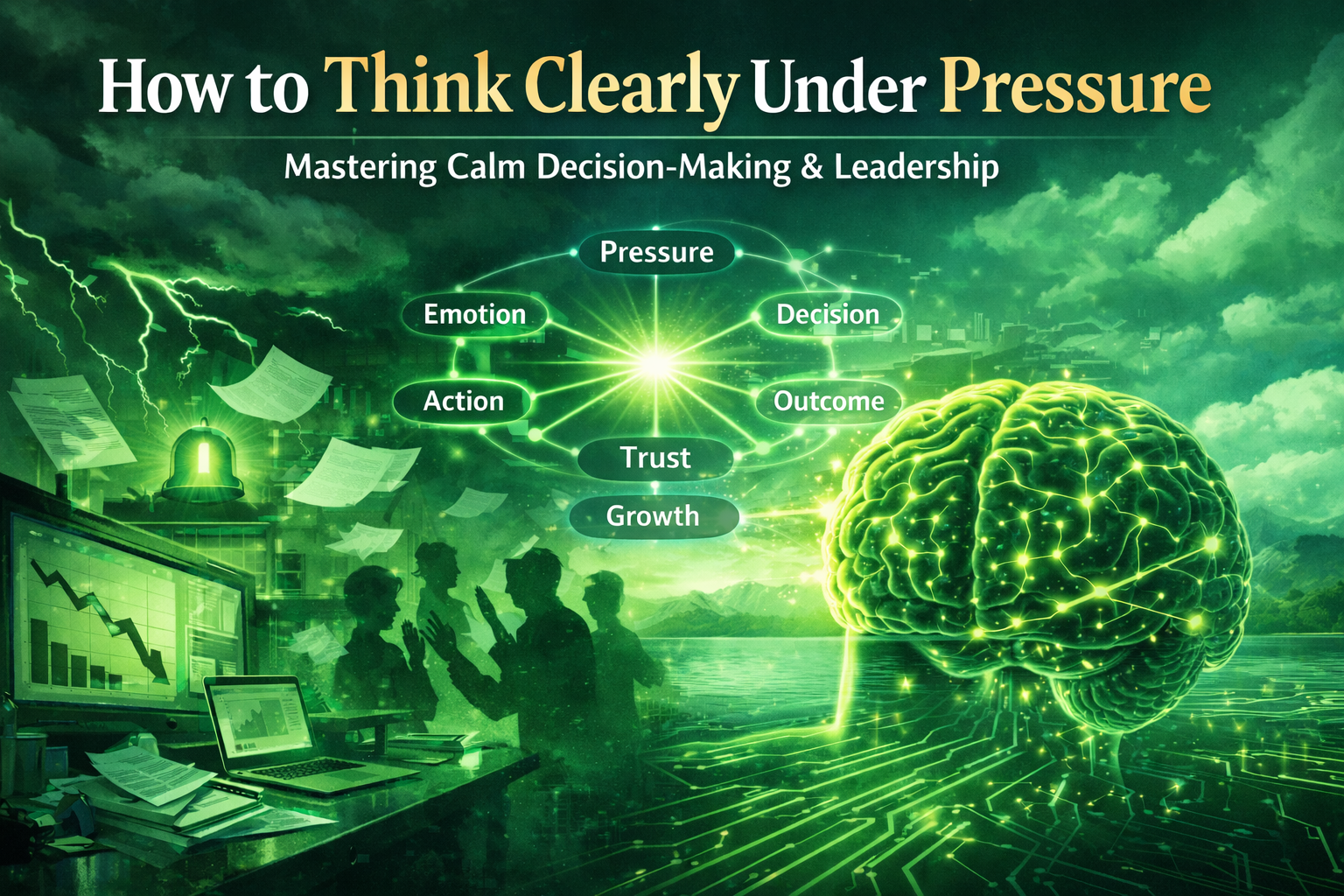
How to Think Clearly Under Pressure: The Science of a Calm Brain
How to Think Clearly
Under Pressure
Stay grounded, make wiser calls, and lead with trust when stakes are high — real-world strategies from ER doctors, air traffic controllers, and executive leaders.
Pause & sense
Notice body tension, shallow breath. Interrupts autopilot.
Slow breath
Inhale 4s, hold 2, exhale 5. Signals safety to brain.
Separate facts
“What do I know?” vs “What do I fear?”
One next step
Focus on one controllable action. Ignore the rest.
Decide & commit
With 70% info, decide. Adjust later.
⏳ This loop takes 60–90 seconds — enough to regain prefrontal control.
Why pressure hijacks your brain
You’re in a critical meeting, the timeline just collapsed, and every eye is on you. Your heart hammers, thoughts scramble, and words feel stuck. This isn’t a lack of intelligence — it’s your ancient brain protecting you from a perceived tiger. The amygdala hijacks your prefrontal cortex, the CEO of rational thought. In the modern world, this “tiger” is a deadline or a crisis, but your body reacts the same: tunnel vision, shallow breath, and reactive emotions.
🔬 Real-world context: A 2022 study of intensive care nurses found that those who practiced a 10-second “pause and label” technique made 37% fewer medication errors. The pause created a cognitive gap between stimulus and action.
But clarity under pressure is trainable. Elite firefighters, hostage negotiators, and surgeons all rely on one foundational skill: creating inner space. That space allows you to choose rather than react.
Reacting vs. Choosing: the 6-second window
An emotional trigger floods your body with stress chemicals for about 6 seconds before the cortex can re-engage. The difference between a disastrous outburst and a measured response lies in what you do in those seconds.
⚡ Reaction loop
Trigger → tension → fast words/action → regret. Common in blame, snap judgments, and that angry email.
🌱 Choice loop
Trigger → pause & observe → choose aligned response → clarity and respect.
How to stretch the gap: Silently say “I notice I’m reacting.” This label activates the prefrontal cortex. Then ask: “What’s needed right now?”
How to slow your mind when everything feels urgent
Hand on chest, breathe in 4, hold 2, out 6. Stimulates vagus nerve.
✅ Air traffic controllers use this between transmissions.
Ask: “What is the one controllable action in the next 5 minutes?” In the Thai cave rescue, divers focused only on the next 20 meters.
Jot two columns: facts vs. fears. Seeing them on paper reduces cognitive load.
🛑 Real-world: A tech lead used a “stoplight” method during a bank outage — Red = certain, Yellow = assumptions, Green = one action. Got systems back 23 minutes faster.
Separating facts from emotions
Emotions are data, not directives. Clarity comes when you act on the fact, not the fear.
| Mistake emotion for fact… | Separate them… |
|---|---|
| “I’m going to be fired” → defensive email, burnout. | “I’m anxious because I care. Fact: last two projects delivered.” |
| “Nobody respects me” → withdraw, passive-aggressive. | “I feel hurt. But fact: I led the last meeting effectively.” |
Emotional labeling in practice
Naming an emotion engages the rational brain. Yale studies found labeling feelings reduces amygdala activity by up to 50%.
Thinking clearly when others are panicking
Panic is socially contagious because of mirror neurons. But so is calm. Your regulated nervous system acts as an anchor for the entire room.
🪢 Anchor principles
Ground yourself in a simple truth: “Our goal is to ensure safety.” Repeat internally. This blocks emotional contagion.
🗣️ Speak calm and low
Lower your tone slightly, slow your speech. FBI agents use this to de-escalate negotiations.
Case: During a warehouse fire, a supervisor stood still while others ran, made eye contact, and said “walk with me to the east exit.” His calm gait made 50 people follow orderly.
Deciding without certainty: the 70% rule
Waiting for 100% clarity guarantees paralysis. Most decisions should be made with 70% of the information you wish you had.
- Reversible vs. irreversible: If you can reverse it, decide quickly. If irreversible, set a hard timer.
- Thresholds: “If I don’t have new data in 20 minutes, I’ll proceed with option A.”
- FOR-DEC: Facts, Options, Risks, Decision, Execution, Check — even a 30-second mental run-through transforms panic into clarity.
“When you have 60% certainty but delaying costs lives, you move. Clarity arrives with action, not before.” — Military commander
Daily disciplines for mental clarity
No phone, no input. Just observe breath. Builds the “pause muscle.”
Each evening: “When did I react vs. choose?” Pattern recognition strengthens foresight.
Cold shower, extra rep, delayed gratification. Teaches your nervous system discomfort is survivable.
From the trading floor: A veteran bond trader visualizes market chaos each morning. When actual volatility hits, his brain responds: “I’ve seen this simulation.” He executes, not panics.
Becoming someone others trust under pressure
Trust is not built in smooth seas. It’s forged when you keep your word while others are losing composure.
- Admit uncertainty calmly: “I don’t know yet, but here’s how I’ll find out.”
- Listen without defense: “So you felt unheard during the project. Tell me more.”
- Recovery, not perfection: “I reacted poorly. Let me rephrase.” This models accountability.
Clarity under pressure isn’t about never feeling fear — it’s about not being owned by it.
Conclusion: pressure as a signal, not a sentence
Every moment of pressure is an invitation: will you react on autopilot, or will you pause, breathe, and choose? The practices above — grounding in facts, slowing physiology, naming emotions, and focusing on the next step — are not just techniques; they’re a path to becoming a person of depth and trust.
Start small. Tomorrow, when a mini-crisis hits, take one conscious breath before responding. Notice how that tiny gap changes everything.
Clear thinking under pressure is the most underrated leadership superpower. Train it.
The fix is grounding and brevity.
- Pause & sip water: 3 seconds of silence looks thoughtful. Use it to breathe.
- Repeat the question: “So you’re asking about Q3 projections…” — buys time.
- One-word anchor on notepad: “breathe” or “slow”. Glance at it.
Competence under crisis is about structuring the unknown.
- State the obvious: “We have a server outage. Let’s gather facts for 3 minutes.”
- Assign roles fast: “Alex: logs. Jess: stakeholders. I’ll coordinate.”
- Narrow the window: “We re-evaluate in 15 minutes.”
- Pre-commit a phrase: “When I feel rushed, I’ll say ‘I need a moment, let’s continue in 5’.”
- Physical reset: Splash cold water on your wrists (vagal stimulation).
- Repair quickly: “I apologize — I’m feeling the deadline pressure.”
Use the recognition-primed decision model:
Reversible → 60% confidence is enough. Irreversible → 80% with a hard stop.
- Write your reasoning at the moment of decision. Revisit when doubt comes.
- Outcome ≠ process. A bad outcome doesn’t mean a bad decision.
- Rumination budget: 5 minutes to review, then redirect.
- Intuition: Calm knowing, quiet pull, no urgency. Consistent over time.
- Anxiety: Urgent, scattered, physical tension. Attaches to worst-case scenarios.
Anxiety shrinks when voiced; intuition stays steady.
Paralysis = dorsal vagal shutdown (freeze response). Way out: gentle movement and orientation.
- Name 5 things you see — engages visual cortex.
- Move: roll shoulders, stand, stretch arms.
- A brief walk (even 2 minutes) signals “I’m not trapped.”
- Slow, steady voice: lower pitch, short sentences.
- Name emotion, then redirect: “I know everyone feels anxious. That’s normal. Here’s what we do first.”
- Give a simple visible task: “Sarah, put the timeline on the whiteboard.”
- “I’m noticing” not “you always”: “I’m noticing the last two reports missed deadline. What’s blocking?”
- Pause for their response.
- End with one clear ask: “Can we agree to send a draft by 2pm tomorrow?”
- Name it simply: “Mama had a hard day, I’m a bit impatient. It’s not your fault.”
- Sensory reset: Step outside for 60 seconds, feel the air.
- Lower the bar: On hard days, survival mode is okay. Connection over perfection.
- Brain dump: Write everything on your mind + a rough next step before bed.
- Calming audio story (not news) distracts the planning mind.
- If awake >20 min, get up. Sit in dim light, read something boring.
- Inform key people: “I’m dealing with a personal matter — I’ll handle essentials.”
- Worry windows: 10 minutes every few hours to feel and process, then return.
- Micro-tasks: Reply one email, file one document. Momentum helps.
Research suggests noticeable changes in 8–12 weeks of consistent micro-practice. But you’ll see small wins immediately — the first time you pause instead of snap. Keep a log of “pressure wins” to stay motivated.